09/28/15
Happy Monday!!!

Do Now:
1. What is your favorite television show? Do you have a favorite episode that you can remember of this television show?
2. Why do you like this show so much?
3. If you don't watch television, do you have a favorite movie? Describe your favorite scene in this movie.
Today, we're going to talk about EPISODIC STORY STRUCTURE. This will prepare us for our first large writing assignment.
The word narrate
comes from the Latin gnoscere, to
know. A narration lets us know something.
It tells us what happened. It
tells us a story.
A narrative is some kind of retelling, often in words (though it is possible to mime a story), of something that happened (a story). The narrative is not the story itself but rather the telling of the story -- which is why it is so often used in phrases such as "written narrative," "oral narrative," etc. While a story just is a sequence of events, a narrative recounts those events, perhaps leaving some occurrences out because they are from some perspective insignificant, and perhaps emphasizing others. In a series of events, a car crash takes a split second. A narrative account, however, might be almost entirely about the crash itself and the few seconds leading up to it. Narratives thus shape history (the series of events, the story of what happened).
A narrative is some kind of retelling, often in words (though it is possible to mime a story), of something that happened (a story). The narrative is not the story itself but rather the telling of the story -- which is why it is so often used in phrases such as "written narrative," "oral narrative," etc. While a story just is a sequence of events, a narrative recounts those events, perhaps leaving some occurrences out because they are from some perspective insignificant, and perhaps emphasizing others. In a series of events, a car crash takes a split second. A narrative account, however, might be almost entirely about the crash itself and the few seconds leading up to it. Narratives thus shape history (the series of events, the story of what happened).
Let's explore an example together:
As we watch this short portion of a film, write about what you see in your notebook. Pretend you are explaining what is going on to your little brother, sister or cousin. Describe the setting, the characters, the event and the outcome. Pretend the reader has never seen this before!!
1:02 - 1:15
Share Out: Small Groups and Whole Group Share Out!
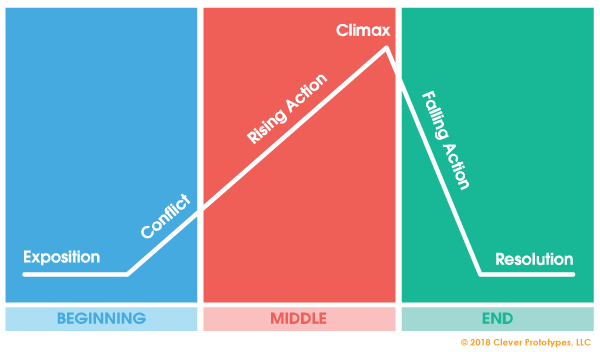
For most films and plays we watch/stories we read, there is a common plot structure. It looks like this:

Tuesday, 09/29/15
TODAY, WE ARE VISITING THE LIBRARY! REMEMBER TO BE ON YOUR BEST BEHAVIOR!!!
Wednesday, September 30th, 2015
TODAY, WE ARE VISITING THE LIBRARY! REMEMBER TO BE ON YOUR BEST BEHAVIOR!!!
Wednesday, September 30th, 2015

Do Now: In list form, write what has happened in your day so far. Be as detailed as you can.
Share Out:
Today, we are going to continue our study of the fictional narrative. Later in the week, we will move from fictional narratives to personal narratives. Learning to tell our own stories is one of the most powerful skills we can develop as learners. We will use the plot structure to help us!
Reminder:
Let's fill out the plot structure for the story so far!
Work Period: Using your "Do Now" we will complete the "Showing Rather than Telling Exercise."
Closing: Shout-Outs and Call-Outs
Thursday/Friday, 10/01/2015 - 10/02/2015

Read Aloud and Annotation: Today, we will start to read a piece of episodic fiction. Please use the annotation instructions we already went over and include the following additional annotation:
Close Reading Annotation Symbols
Symbol
|
What this symbol represents...
|
What to write as your annotation
|
+
|
I agree with what the text/author says here!
|
Explain why you agree with the text/author.
|
I disagree with what the text/author says here!
|
Explain why you disagree with the text/author.
| |
underline
|
Important information, key ideas/concepts
|
Summarize or paraphrase the important information/ideas.
|
?
|
Information you are confused about or doesn’t make sense
|
Compose a question to express what confuses you.
|
=
|
Information that reminds you of something you’ve read/heard/seen before
|
Discuss the connection you are making between this information and previously read/heard/seen information
|
Put a circle around words you are unfamiliar with
|
Look up the word and write a brief definition in the margin.
| |
Every annotation has two elements: A symbol AND a sentence.
- Symbol: Put a symbol from the chart above on the relevant part of the text.
- Sentence: Closely reading a piece of text does you no good if you later forget why you make the annotation. The symbols will help remind you, but they are not enough! You MUST write a sentence to go along with your symbol
- If a passage was confusing, write down a question.
- Making a connection? To what are you connecting this information?
- If you agree/disagree with an author write why.
- DO NOT write phrases like “Wow!” or “This is cool!”
- Be specific - Your future self will thank you!
Reminder:
Circle trouble words!
Exclamation point for anything shocking or surprising!
Question mark if anything seems confusing or troubling.
***In the margins, write down CHARACTER TRAITS of either Mrs. H.T. Miller or Miriam. Draw an arrow if there is room. I will demonstrate on the overhead for the first page.
Work Period: Using your "Do Now" we will complete the "Showing Rather than Telling Exercise."
Closing: Shout-Outs and Call-Outs
Thursday/Friday, 10/01/2015 - 10/02/2015

Do Now: Take out your books and dive in! Enjoy the time to read quietly. Please have your independent reading logs out and your annotation homework assignment on your desk for a quiet check.
Check-in: Writing Standards. What are we building towards?
Warmup Activity: Just like we listed the events in our morning yesterday, list the events that have occurred in "Miriam" so far, leaving out any descriptive language, judgements or dialogue.
Annotation Practice: We will continue practicing our annotation strategies as we continue to read "Miriam." We will do two paragraphs together and then you will annotate as I read up to page 10. As we read, pay careful attention to descriptive words and phrases. Remember: Excellence is in the DETAILS!
Group Work Period (25 minutes): In your table groups, turn to the exercise in "Showing Rather than Telling" in your narrative packets. You will work together to turn the LIST of events into an ENTERTAINING and VIVID story.
Each group member must assign:
1. A writer (this person will record the story)
2. A reader (this person will read the story when it is finished)
3. A facilitator (this person must guide the discussion and keep everyone on task)
4. A time-keeper (this person must carefully watch the clock and inform the other members regarding time)
As a group, can you turn this narration into a story your classmates want to read? Stick to the events listed, but otherwise, you may be CREATIVE!!
Share Out: Students will share their stories with the class!
Closing: Shout-Outs and Call-Outs!
Check-in: Writing Standards. What are we building towards?
Write narratives to develop real or imagined experiences or events using effective technique, relevant descriptive details, and well-structured event sequences.
CCSS.ELA-LITERACY.W.8.3.A
Engage and orient the reader by establishing a context and point of view and introducing a narrator and/or characters; organize an event sequence that unfolds naturally and logically.
Engage and orient the reader by establishing a context and point of view and introducing a narrator and/or characters; organize an event sequence that unfolds naturally and logically.
CCSS.ELA-LITERACY.W.8.3.B
Use narrative techniques, such as dialogue, pacing, description, and reflection, to develop experiences, events, and/or characters.
Use narrative techniques, such as dialogue, pacing, description, and reflection, to develop experiences, events, and/or characters.
Warmup Activity: Just like we listed the events in our morning yesterday, list the events that have occurred in "Miriam" so far, leaving out any descriptive language, judgements or dialogue.
Annotation Practice: We will continue practicing our annotation strategies as we continue to read "Miriam." We will do two paragraphs together and then you will annotate as I read up to page 10. As we read, pay careful attention to descriptive words and phrases. Remember: Excellence is in the DETAILS!
Group Work Period (25 minutes): In your table groups, turn to the exercise in "Showing Rather than Telling" in your narrative packets. You will work together to turn the LIST of events into an ENTERTAINING and VIVID story.
Each group member must assign:
1. A writer (this person will record the story)
2. A reader (this person will read the story when it is finished)
3. A facilitator (this person must guide the discussion and keep everyone on task)
4. A time-keeper (this person must carefully watch the clock and inform the other members regarding time)
As a group, can you turn this narration into a story your classmates want to read? Stick to the events listed, but otherwise, you may be CREATIVE!!
Share Out: Students will share their stories with the class!
Closing: Shout-Outs and Call-Outs!